Cutting Connection Why the Social and Community Participation Cuts Are the Reform Providers Aren’t Ready For
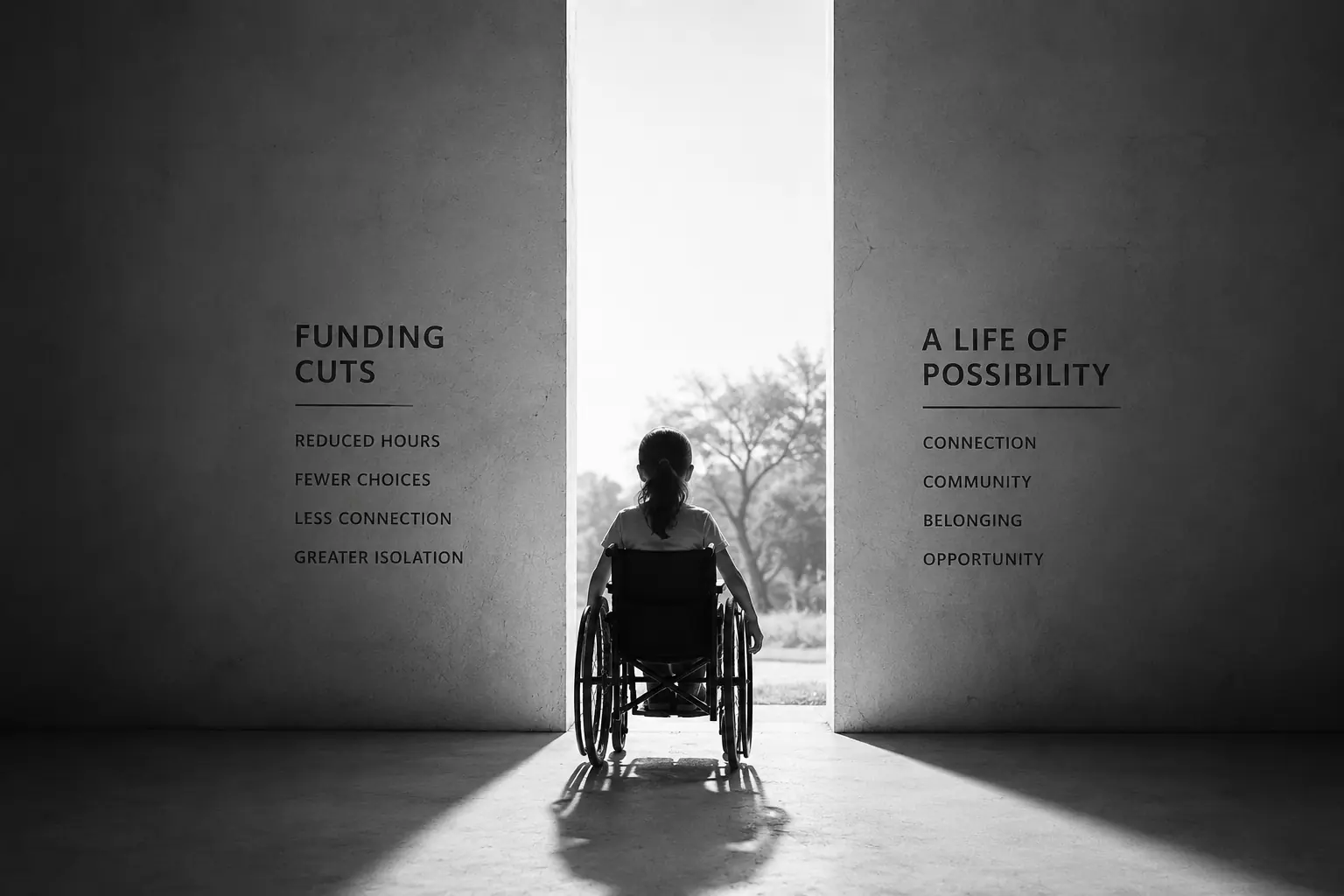
“These are not bureaucratic changes. They determine whether a person with disability leaves their home, connects with others, builds skills, and lives a life of any real breadth.”
Of all the reforms in the Securing the NDIS for Future Generations package, the cuts to social and community participation funding will be felt first, felt hardest, and felt by the people least able to absorb them.
For many participants, this funding is not a discretionary add-on. It is the plan. Yet across the sector, the implementation process — how the cuts will be applied, to whom, and on what timeline — remains poorly understood. Providers are forecasting on incomplete information. Participants are anxious without knowing what to prepare for. Government messaging has been inconsistent.
This article sets out the facts: what is being cut, how the mechanism works, the precise timeline, and what the Inclusive Communities Fund is — and is not.
The Numbers: Why 30% and 50% Are Both Correct
Confusion about the size of the cut is widespread. Both figures are accurate — they refer to different things.
• 30% — the expected reduction in actual participant spending • 50% — the reduction in budget allocations for social, civic and community participation
Because many participants under-utilise their allocation, a 50% cut to the allocation is designed to produce an average 30% reduction in spending.
But for participants who use most of their allocation — and for providers whose programs rely on those hours — the operative number is 50%.
Capacity building daily activity budgets will also reduce by 10%, affecting skill development and structured programs often delivered by the same providers.
The Mechanism: A Ministerial Determination, Not a Planning Process
The most important — and least understood — element of the reform is the budget reset mechanism.
Under Part 4 of the Bill, the Minister can issue a legislative instrument that resets funding for entire support categories. This is:
• not an individual assessment • not a planner decision • not subject to sunsetting • not reviewed by Parliament
It is an administrative instrument applied across the board as plans renew.
Participants are not notified that a ministerial determination caused the reduction. They discover it when their new plan arrives.
“This is not a planning process. It is a mass administrative reset. The only variable is timing.”
The Timeline: What Happens and When
The cuts do not arrive in one moment. They roll through the system over roughly 12–14 months.
June 2026 — Legislation expected to pass Tighter criteria for unscheduled plan reassessments take effect almost immediately.
July 2026 — New digital payments system begins NDIA gains real-time visibility into provider claims. Providers must tighten documentation.
1 October 2026 — First plans roll over with reduced allocations Participants with October renewals will be the first to receive plans with: • 50% reduction to social/community participation • 10% reduction to capacity building daily activities
October 2026 – September 2027 — Rolling implementation As each participant’s plan renews, the cuts apply. Providers will see a gradual but accelerating decline in available hours.
1 December 2026 — 90-day claim window begins Claims older than 90 days will not be payable.
Early 2027 — Tighter ‘reasonable and necessary’ criteria Greater evidence will be required to justify community participation supports.
1 April 2027 — New planning framework begins The three-bucket structure transitions to flexible and stated categories.
Mid-2027 — Possible opening of the Inclusive Communities Fund If consultation proceeds as planned, grants may begin flowing — but not to participants, and not at a scale that replaces lost funding.
The Inclusive Communities Fund: What It Is and Isn’t
The $200 million Inclusive Communities Fund has been positioned as the answer to concerns about reduced individual budgets. It is not.
• It is not yet designed. • It is not yet allocated. • It will not be available in 2026. • It is aimed at community organisations — not NDIS providers. • It does not replace individual participant funding.
Current annual spending on social and community participation is approximately $12 billion. The government is targeting a $3.6 billion annual reduction. The Fund is $200 million total.
“The Fund replaces roughly five cents in every dollar being removed from individual plans.”
It is a community development program — not a business continuity strategy.
What This Means for Providers
If your organisation delivers social and community participation supports — group programs, community access, recreation, skills groups — you will experience a direct and material reduction in revenue.
The magnitude depends on your participant mix and plan anniversary profile. Some providers will feel the impact from November 2026. Others will have more runway.
Every provider in this space should now:
• Map participant plan renewal dates and model revenue quarter by quarter to Q4 2027 • Review service mix and identify supports protected from cuts • Assess group program viability under reduced budgets • Strengthen documentation of outcomes and goal alignment • Prepare for the 90-day claim window • Engage early with participants and support coordinators
This is not a time for passive observation. It is a time for operational clarity.
The Human Cost Behind the Policy
For many participants — particularly those with intellectual disability, autism and psychosocial disability — structured community participation is not optional enrichment. It is the foundation of stability, connection and wellbeing.
Cuts without credible alternatives increase isolation, mental health risk, carer burnout and long-term support costs. The people most affected are those least equipped to navigate the system or advocate for themselves.
Providers, support coordinators and advocates have a responsibility to be proactive — not reactive.
The Bottom Line
The social and community participation cuts are not a distant policy risk. They begin in October 2026 and will roll through the participant cohort over the following year.
The replacement — the Inclusive Communities Fund — will not be operational in time to bridge the gap.
What the sector can do now is act on information, not anxiety: model exposure, diversify services, strengthen evidence, and engage in every consultation process.
The legislation is progressing. But implementation — the detail, the safeguards, the pace — is still being shaped.
That window is open now.
About the Author
Jeanette Larsen is a respected disability sector leader with deep expertise in SCHADS, workforce strategy, NDIS operations and provider sustainability. With a background spanning finance, HR, business leadership and operational management, she brings a clear, grounded understanding of how policy, awards and workforce pressures play out in real organisations. Jeanette writes about SCHADS, workforce design, governance and the practical realities facing disability providers navigating complexity, compliance and change.
Disclaimer: This article reflects general insights and sector commentary. It is not legal or industrial relations advice. Organisations should seek independent guidance before making decisions about SCHADS, workforce arrangements or compliance.